Thursday, February 9, 2012 | By: GirlsWannaRead

The End of an Era in Publishing?


Call me a pessimist, call me Ishmael, but I think that book publishing is about to slide into the sea. We live in a literate time, and our children are writing up a storm, often combining letters and numerals (U R 2 1derful), blogging like crazy, reading for hours off their little screens, surfing around from Henry James to Jesse James to the epistle of James to pajamas to Obama to Alabama to Alanon to non-sequiturs, sequins, penguins, penal institutions, and it's all free, and you read freely, you're not committed to anything the way you are when you shell out $30 for a book, you're like a hummingbird in an endless meadow of flowers.

GARRISON KEILLOR, "The End of an Era in Publishing," A Prairie Home Companion, May 25, 2010


     There is much discussion these days about the future of printed books, libraries, and publishing itself.  I came across this quote from Garrison Keillor and it made me ponder again where we are headed and how I feel about it.  I am not among the younger generation who have grown up with the internet.  I love my blog, I love Googling my every curiosity, I love having information at the tip of my fingers - but I also love my physical books.  That said, I year ago I said I would never buy a Kindle and now I have to admit I want one and will probably acquire one before year's end.   Reading an electronic book is still reading.  Is my desire for traditional printed books just clinging to habit, desiring an old comfort?
     What do you think?  Do you have opinions you'd like to share?  I'd love to hear them.

~ Frances

Bookish Quotes #35

"Books are lighthouses erected in the great sea of time."
~ Edwin P. Whipple

"Book lovers will understand me, and they will know too that part of the pleasure of a library lies in its very existance."
~ Jan Morris
Wednesday, February 8, 2012 | By: GirlsWannaRead

Waxing Poetic: The Thought by Mary Webb

     Mary Webb (1881–1927), was an English romantic novelist and poet of the early 20th century, whose work is set chiefly in the Shropshire countryside and among Shropshire characters and people which she knew. Her novels have been dramatized, most notably the film Gone To Earth in 1950.  Her novels, along with several other novelists of the time, inspired Stella Gibbons famous parody Cold Comfort Farm.
     She spoke negatively about her writing, called herself “wholly un-gifted”, and said she sometimes felt “whelmed in remorse & terror” over her perceived literary mistakes.  In her own lifetime, she won the Prix Femina Vie Heureuse for Precious Bane, but her output was not otherwise greatly esteemed. Her schoolteacher husband abandoned her; she burned drafts of her novels to keep warm.  It was only after her death that Stanley Baldwin, then Britain's Prime Minister, brought about her commercial success through his approbation; at a Literary Fund dinner in 1928, Baldwin referred to her as a neglected genius.

The Thought

As a pale moth passes
In the April grasses,
So I come and go,
Softlier than snow.
Swifter than a star
Through the heart I flee,
Singing things that are
And things that cannot be.
I whisper to the mole
And the cold fish in the sea,
And to man's wistful soul
God sendeth me.
As a grey moth passes
In October grasses,
So I come and go,
Softlier than snow.
Thursday, February 2, 2012 | By: GirlsWannaRead

Christmas Holiday - W. Somerset Maugham


     While it might seem odd to read a novel titled Christmas Holiday in January, Maugham's book is as far removed from a feel good Christmas story as possible.  That said, I loved it.  Written in 1939, just before the outbreak of WWII. it was an attempt by Maugham to wake up the British to what was happening in Europe.
     Charley, a 23 year old who has completed his studies at Cambridge and a year in his father's business, is given a Christmas trip to Paris by his father.  It is his first trip alone and he sails off to have the time of his life in spite of the brewing political situation in Europe.  He plans to meet up with his childhood friend, Simon Fenimore, who has a job in Paris as a foreign correspondent and intends to get some experience in Europe before returning to England to stand for Parliament as a Labour candidate.  Simon, an orphan, has always been a surly loner but Charley finds that his has become a Communist and has no smaller goal than to take over the world.  He has become contemptuous of Charley's middle-class life.
     As an attempt to indulge Charley's desire for adventure, he takes him to a brothel where he introduces him to Princess Olga, a Russian immigrant, and proceeds to desert him.  Charley, while wanting to stay with the girl, wants to go to the Christmas eve midnight mass.  He tells her that he will be back in an hour but she begs him to take him with her.  So begins a companionship that lasts for his five days in Paris.
     He learns that she is really Lydia, a young Russian woman who was left homeless after the outbreak of the Bolshevik revolution and fled the country. In France she married Robert Berger, a rake who was later sentenced to fifteen years’ penal servitude for murder. Having covered the trial for the press, Simon is well aware of this, and knew exactly what he was letting his friend in for. She has since had to become a prostitute but it is not primarily in order to make ends meet but as a penance for her husband's sin.  He brings her to his hotel where they live together for his stay, but the relationship is platonic.  Over the course of his stay, she tells him the story of her unhappy life which fills up the greater portion of the novel.
     Lydia's story and Simon's vehement radicalism disrupt Charley's complacent life and cause him to question the meaning of his life.  His glimpse at a world formally unknown to him make him reevaluate his beliefs and priorities.  The contrast between Charley's sheltered English life with the life of those he meets in Paris is one of the things Maugham does best.  The essence of pre-war Paris is captured perfectly.  The characters are also wonderfully well drawn.
     What happens in Paris goes back with Charley and the cozy family he left seems shallow.  The last lines of the novel are powerful and moving.  I chose this novel without knowing much at all about it and it is now one of my favorite of Maugham's works.


~ Frances

Bookish Quotes #34

“A good book is an education of the heart. It enlarges your sense of human possibility what human nature is of what happens in the world. It’s a creator of inwardness.”
~ Susan Sontag

 “Reading brings us unknown friends.”
~ Honoré de Balzac
Wednesday, February 1, 2012 | By: GirlsWannaRead

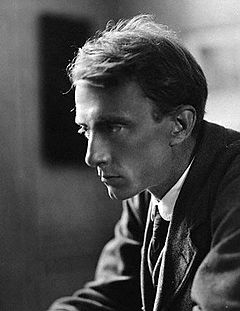
Waxing Poetic: Like the Touch of Rain by Edward Thomas


   Philip Edward Thomas (3 March 1878 – 9 April 1917) was an Anglo-Welsh writer of prose and poetry. He is commonly considered a war poet, although few of his poems deal directly with his war experiences. Already an accomplished writer, Thomas turned to poetry only in 1914. He enlisted in the army in 1915, and was killed in action during the Battle of Arras in 1917, soon after he arrived in France.


Like the Touch of Rain


Like the touch of rain she was
On a man's flesh and hair and eyes
When the joy of walking thus
Has taken him by surprise:

With the love of the storm he burns,
He sings, he laughs, well I know how,
But forgets when he returns
As I shall not forget her 'Go now'.

Those two words shut a door
Between me and the blessed rain
That was never shut before
And will not open again.